
Phased array pipe inspection represents a major advancement in nondestructive testing technology. Unlike traditional ultrasonic methods that require constant manual probe movement, this advanced technology uses electronically controlled ultrasonic pipe inspection equipment and ultrasonic pipe testing equipment to steer, focus, and scan beams in real time — delivering faster, more accurate, and fully automated defect detection.
In this comprehensive guide — written by NCS Testing Technology Co., Ltd. — we explain the principles, capabilities, and industrial applications of phased array pipe inspection, highlighting how advanced ultrasonic testing can improve defect detection, ensure consistent quality, and support reliable production processes for pipes and steel bars.
Phased array pipe inspection is an advanced ultrasonic testing (UT) method that uses multi-element probes to electronically steer, focus, and scan ultrasonic beams through pipe material.
Unlike conventional ultrasonic testing—which uses a single fixed-angle transducer—phased array systems control multiple probe elements independently. By adjusting timing (phasing), the system can:
Change beam angles electronically
Focus at specific depths
Sweep through a range of angles without moving the probe
Generate real-time imaging of defects
This makes phased array UT equipment one of the most powerful forms of ultrasonic pipe inspection equipment available today.
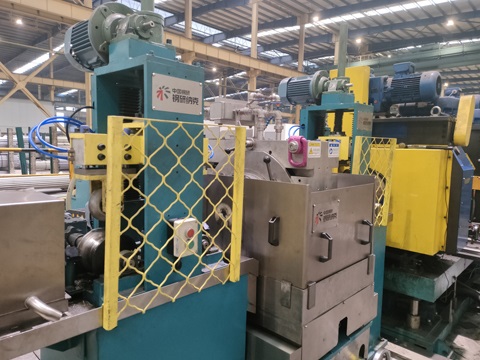
At its core, phased array pipe inspection is based on the same ultrasonic principles as conventional UT, but electronic control changes the capabilities dramatically. Each phased array probe contains multiple individually addressable piezoelectric elements. By firing these elements with precisely calculated time delays, the system generates a focused ultrasonic beam that can be electronically steered to various angles, focused at different depths, and scanned across the entire circumference or length of the pipe.
Key scanning modes used in pipe inspection include:
S-Scan (Sector Scan): Fan-shaped sweep ideal for weld and volume inspection
L-Scan (Linear Scan): Electronic scanning along the pipe length
Daisy / Circumferential Arrays: Configurations for full 360° inspection of pipes and bars
The result is real-time imaging that accurately shows defect location, size, and depth, with automatic recording and reporting capabilities — delivering the precision and traceability required in modern industrial production.
Feature | Conventional UT | Phased Array Pipe Inspection (NCS System) |
Beam Control | Fixed angle, manual movement | Electronic steering + focusing |
Coverage per pass | Narrow | Full sector or circumferential |
Inspection Speed | 5–15 m/min | 0–50 m/min |
Defect Detection (Transverse/Longitudinal/Delamination) | Good (multiple probes needed) | Excellent (single probe setup) |
Wall Thickness Mapping | Point-by-point | Continuous real-time |
Dead Zone | Larger | 0 mm |
Missed Detection Rate | 1–5% | 0% |
Data Recording | Manual | Automatic storage + report generation |
Operator Dependency | High | Low (automated + audio/visual alarms) |
Phased array pipe inspection delivers higher Probability of Detection (POD), dramatically reduced inspection time, and permanent digital records that meet or exceed API, ASTM, and EN standards.
Manual UT remains common for field inspections. However, in steel mills and pipe production plants, automation is critical.
Benefits of Automated Ultrasonic Pipe Testing Equipment:
100% inspection coverage
Reduced human error
Consistent calibration
Digital traceability
Integration with production lines
Higher inspection speed
Automation transforms phased array from a laboratory technique into an industrial quality-control backbone.
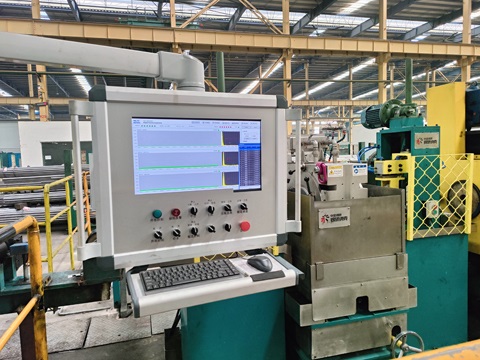
Phased array systems are widely used in:
Seamless steel pipe manufacturing
Welded pipe production
Oil & gas transmission pipelines
Pressure vessels
Structural steel bars and rods
Railway wheels and heavy machinery components
In high-volume steel production, automated phased array lines ensure every meter of pipe meets international inspection standards.
1. Advanced Phased Array Probe Control
Each probe element is individually addressable. This enables precise beam steering and focusing, improving detection sensitivity across varying wall thicknesses.
2. Intelligent Virtual Channel Technology
Multi-element virtual channels allow dynamic beam configuration without adding hardware complexity. This ensures full pipe coverage with fewer mechanical adjustments.
3. Performance Excellence
High-speed inspection
Exceptional sensitivity
Reduced machining precision requirements
Stable performance in industrial environments
4. Operational Efficiency
Simple maintenance procedures
Durable components
Automatic data/image storage
Built-in report generation
For manufacturers running 24/7 production lines, these features significantly reduce operational costs.
In modern steel production, quality assurance must balance:
High throughput
Strict compliance standards
Zero-defect tolerance
Full documentation traceability
Phased array pipe inspection systems provide:
Real-time defect imaging
Automatic rejection marking
Data archiving for audits
Statistical quality analysis
This not only protects downstream customers—but also strengthens brand reputation and regulatory compliance.
NCS Testing Technology is a subsidiary of China Iron & Steel Research Institute Group.
To date, the company has:
Delivered nearly 600 sets of fully automated inspection lines/systems
Supplied systems utilizing UT, ET, MFL, and MPT methods
Served industries including metallurgy, petrochemicals, railways, and machinery manufacturing
Installed inspection lines for seamless pipes, welded pipes, steel bars, steel plates, and railway wheels
Sold over 1,000 standalone NDT instruments, including ultrasonic flaw detectors and EMAT systems
With hundreds of enterprise installations, NCS provides reliable, large-scale ultrasonic pipe inspection equipment tailored for industrial production environments.
What defects can phased array pipe inspection detect?
It can detect transverse cracks, longitudinal cracks, delamination, inclusions, and wall thickness variations.
Is phased array suitable for seamless and welded pipes?
Yes. It is highly effective for both seamless and welded pipes, especially in automated production lines.
What industries require ultrasonic pipe testing equipment?
Oil & gas, petrochemical, power generation, railway, heavy machinery, and steel manufacturing industries rely heavily on ultrasonic inspection systems.
Can phased array systems be customized?
Yes. Diameter ranges, speed, probe configurations, and power supply standards can be customized according to plant requirements.
Is phased array pipe inspection suitable for titanium and copper? Absolutely — any material that transmits ultrasonic waves works, including titanium bars and copper tubes.
For manufacturers seeking reliable ultrasonic pipe inspection equipment or scalable ultrasonic pipe testing equipment, phased array systems provide a future-proof solution that balances precision, productivity, and cost efficiency.
If you are looking for reliable, proven ultrasonic pipe inspection equipment or ultrasonic pipe testing equipment that delivers 0% missed detection and full automation, contact NCS today.
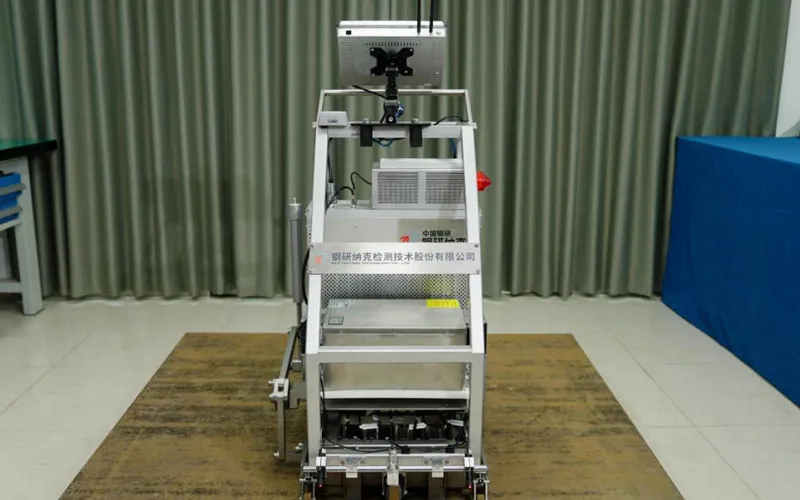
NCS-MMTI200 steel plate hard spot micro-magnetic NDT trolley system

NCS Exhibits Automated NDT Equipment and NDT Instrument Calibration Systems at ECNDT 2026
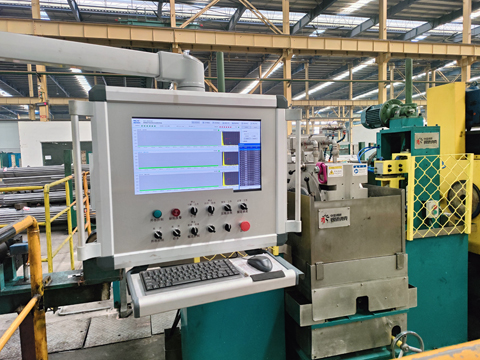
What Is Phased Array Pipe Inspection? Complete 2026 Guide to Phased Array Ultrasonic Testing for Pipes & Bars
 English